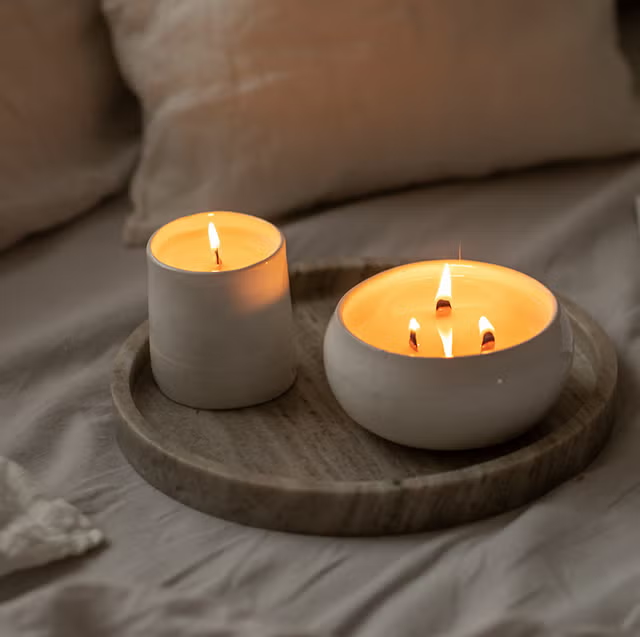
There’s something almost sacred about lighting a candle. The soft hiss of a struck match, the slow bloom of warmth across a room, the way a single flame can transform an ordinary Tuesday evening into something that feels intentional. For millions of people, candles are less a home accessory and more a daily ritual, a signal to the nervous system that it’s time to exhale. But what if the very thing you’re reaching for to decompress is quietly working against you?
What’s actually burning in your living room
Indoor air quality has become one of the more quietly alarming public health conversations of the last decade. Studies from the Environmental Protection Agency have found that indoor air can be two to five times more polluted than the air outside, and in some cases, up to 100 times worse. Candles, particularly the conventional kind lining drugstore shelves and big-box stores, are a meaningful contributor to that problem.
The issue begins with the wax itself. The vast majority of mass-market candles are made from paraffin, a byproduct of petroleum refining. When paraffin burns, it releases a range of volatile organic compounds, including benzene and toluene — chemicals also found in diesel exhaust. Dr. Anne Steinemann, environmental engineer at the University of Melbourne and one of the leading researchers on chemical emissions from consumer products, has spent years documenting exactly what gets released into the air we breathe. Her findings are difficult to ignore: in a landmark study published in Air Quality, Atmosphere & Health, she identified acetaldehyde, benzene, and formaldehyde among the compounds emitted by common scented products, several of them classified as toxic or hazardous under federal law. “Fragrance chemicals in consumer products are largely unregulated,” she has written, “and consumers have little way of knowing what they’re being exposed to.”
Beyond the wax, synthetic fragrance is its own category of concern. A single “fragrance” listed on a label can legally represent a proprietary blend of hundreds of chemical compounds, many of which never have to be individually disclosed to consumers. Among them are phthalates — a class of chemicals used to help scent linger longer — which have been linked to endocrine disruption and are of particular concern for children and people who are pregnant. A 2021 analysis published in Chemosphere identified more than 150 distinct volatile compounds emitted from scented candles during normal use, including several classified as hazardous air pollutants under federal guidelines.
Dyes used to color candles can introduce heavy metals into the air as well, while conventional wicks, often stiffened with metal cores, have historically been a source of lead emissions, though lead wicks were banned in the U.S. in 2003. Still, imported candles of unclear origin can slip through.
The ingredient list nobody reads
Part of what makes this problem so persistent is that candles, unlike food or cosmetics, face relatively minimal labeling requirements. There’s no standardized disclosure for the dozens of chemicals that may be present in a fragrance blend, no requirement to list wax source or wick composition. Consumers are largely left to research on their own or simply trust the vibe of a well-designed jar.
Dr. Philip Landrigan, pediatrician and director of the Program for Global Public Health and the Common Good at Boston College, has been one of the most prominent voices calling out this systemic gap. His concern extends well beyond candles, it’s about the broader failure of chemical regulation in everyday consumer products. “We are essentially conducting a vast, uncontrolled experiment on the health of our children,” he has said, a charge that lands with particular weight in the context of products routinely burned in homes where children sleep, eat, and spend the majority of their time.
A survey conducted by the American Lung Association found that a majority of Americans were unaware that burning candles — even scented ones marketed as “natural” — could contribute to indoor air pollution. Only a fraction said they ventilated their space while burning candles, and fewer still reported trimming wicks or following any burning guidelines.
What a better candle actually looks like
The good news is that a growing wave of independent American candle makers has spent the last several years building a genuinely different product. They’re swapping paraffin for non-GMO soy wax, coconut wax, and beeswax, each with meaningful advantages over their petroleum-derived predecessors.
Beeswax is widely considered the gold standard. It burns cleanly, produces very little soot, and emits negative ions during combustion — particles that can bind with dust, allergens, and other airborne pollutants and help pull them out of the air rather than adding to them. It also carries a subtle, natural honey scent that requires no added fragrance to feel warm and inviting. Coconut wax, derived from cold-pressed coconut oil, has gained significant ground as well — it burns slowly and evenly, holds fragrance well without synthetic boosters, and is both renewable and biodegradable.
Wicks in cleaner candles are typically made from unbleached 100% organic cotton or hemp, sometimes woven around a paper core for structural support and pre-waxed with vegetable wax to eliminate the need for metal stiffeners. It’s a small detail that makes a measurable difference in what you’re inhaling.
When it comes to scent, the better brands are reaching exclusively for essential oils and botanical extracts rather than synthetic fragrance compounds. The result is often a subtler, more complex scent profile, less the aggressive sweetness of a commercial candle, more the quiet presence of something that actually came from a plant.
A number of U.S.-based brands have become recognized leaders in this cleaner category, among them P.F. Candle Co., which uses domestically grown soy wax and phthalate-free fragrance oils; Fontana Candle Company, known for its beeswax and essential oil formulations; The Slow North, which produces small-batch soy and coconut wax candles scented entirely with essential oils; Brooklyn Candle Studio, which has built a following for its minimalist aesthetic and clean ingredients; and Keap Candles, which has made sustainability central to both its formulation and packaging. Many of these brands also offer refill programs, allowing customers to return vessels and reduce waste over time.
The vessels themselves have become a canvas for creativity and responsibility. Upcycled glass, hand-thrown ceramics, and reclaimed materials are all part of the conversation, containers designed not to be discarded after the last burn, but repurposed, refilled, or kept on a shelf long after the wax is gone.
Burning smarter
Even the cleanest candle involves combustion, and combustion always produces some byproducts. Scientists are clear that no candle is entirely without impact: the goal is simply to minimize it. A few practices make a meaningful difference.
Trim your wick to about a quarter inch before every burn. A longer wick produces a larger, less stable flame that generates more soot and burns through wax unevenly. Burn candles in well-ventilated rooms whenever possible, and crack a window — especially in smaller spaces. Avoid burning candles for more than three or four hours at a stretch. And when you extinguish a flame, use a snuffer rather than blowing it out, which sends a plume of smoke directly into the air you’re breathing.
The ritual of a candle is still worth preserving. The flickering light, the scent that slowly fills a room, the particular quality of attention it seems to invite. These things are real, and they matter. It just turns out that with a little more care in what you choose to light, you can have that experience without the chemical trade-off. The right candle doesn’t ask you to choose between comfort and health. It offers both.
beauty beauty trends celebrities celebrity news christmas coffee dating fall fashion fashion fashion designers fashion trends fashion week fitness hailey bieber hairstyles hair trends halloween harry potter health holidays Instagram jewelry Justin Bieber kate middleton King Charles meghan markle mental health milan fashion week movies music netflix paris fashion week prince harry princess diana prince william relationships royal family royals skincare street style television tennis travel valentine's day wellness
